|
 The Holiday Inn Beach at I-30 The Holiday Inn Beach at I-30
Ft. Worth, TX
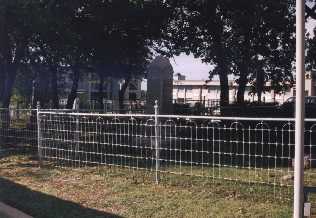
Probably the only hotel in the world with it's own
cemetery on it's grounds.
In 1970 a Mr. John Hickman of Ft. Worth and Judge Robert Hall of Dallas
decided to build a hotel on the Sycamore Heights Bluff overlooking the
then Fort Worth-Dallas Turnpike, but they had two problems. One, there
appeared to be a small private cemetery right where they wanted to build
the hotel. The cemetery is the Pioneer Ayres Graveyard. Buried there is
Benjamin Ayres and his wife Emily. Four of his six sons are buried here,
John, Joe, C.A., and Ben, Jr. Also buried on the hotel grounds are
Isabella Sanderson, Ayres daughter and her husband, William Sanderson.
Another daughter Mary Ayres Cushman born Dec. 22, 1874, died Aug. 23, 1952
is also interned here. Over the years many others were buried in this two
acre plot, some friends and some strangers, many of them children who died
while traveling West by wagon.
Mr. Hickman decided to leave the
cemetery and build the hotel around it. It has become quite a tourist
attraction over the years. Mr. Hickman promised to give the cemetery
perpetual care.
Now to the other problem. It was a stinky one. A pig
farm located just to the west of the proposed hotel and south of the
Turnpike. What to do? The Ft. Worth City Council tried to discourage it by
declaring the pig business a nuisance and a zoning violation. But, the pig
farmers stayed.
(Editor's note: I remember just after the Turnpike was built and in the
days before most cars had air conditioners whenever we would pass the pig
farm we would roll up our windows to keep out the smell. It didn't work.
P-U-EE!)
Finally, the owners of the pig farm, worn out by the constant hassle,
sold out. A Federal Agricultural Building was built soon after on the site
and the hotel soon after that.
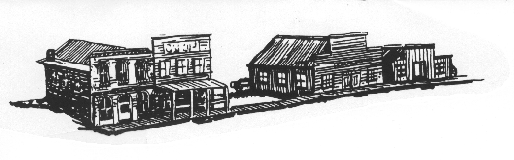
After Fort Worth was abandoned by the Army in 1853, merchants and
traders took over the empty buildings. They called the new town "Fort Town
". By 1856 Fort Town was again being known as "Fort Worth". Aren't you
glad? "Yes, I am from Fort Town" doesn't sound as cool as "Yep, I'm from
"Foat Wuth". |
 (Editor's note: I seem to recall that when the Turnpike
was built it split the pig farmer's land into with no access to the north
side of the Turnpike. I had heard that a tunnel was built under the
Turnpike to allow access to the other side. I may check this out
someday.) (Editor's note: I seem to recall that when the Turnpike
was built it split the pig farmer's land into with no access to the north
side of the Turnpike. I had heard that a tunnel was built under the
Turnpike to allow access to the other side. I may check this out
someday.)
Benjamin Ayres came to Tarrant County in 1848 from Tennessee.
He was probably pretty wealthy as he had sold his plantation to come here.
Mr. Ayres claimed his land on Sycamore Creek. He owned 320 acres in what
is now Meadowbrook. He was active in local politics and helped organize
the First Christian Church in Fort Worth in 1851. The Christian Church he
helped organize still stands today at 6th and Throckmorton Sts.
Ben
Ayres served as Tarrant County's second County Clerk from 1852 to 1856. He
died in 1862. Ayres Street is named for him.
(Editor's note: Okay, I
check out the tunnel story. There is not one as such. Mr. Miller (pig farm
owner) had his 100 pig farm right on Sycamore Creek. When they built the
Turnpike over Sycamore Creek, they left enough room on both sides of the
creek under the bridge to drive over to the north side of the
Turnpike.)

MODERN DRUG STORE sign at
corner of Hemphill and Magnolia. This two story brick building was built
in 1927. First business was W. B. LaCava Clothes Cleaning business. In
1939, Modern Drug Store opened.
|
|
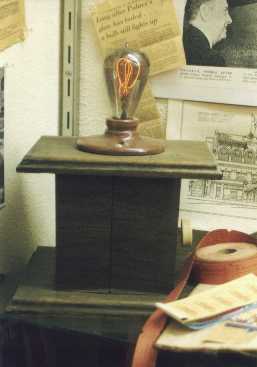
This is
the famous Palace Theater Light Bulb. This Carbon Filament Light Bulb has
been burning almost continuously since it was installed on September 21,
1908.
It was installed by stage electrician Barny Burke to light the
area around the stage door of the old Byers Opera House which later became
the Palace Theater. Only once did it go out very briefly. In 1970 someone
flipped lever to off and the bulb went out. The switch was quickly flipped
back on and the bulb glowed again.
The bulb was mentioned in 'Ripley's
Believe It or Not' after it had been burning a little over 30
years.
The Palace was located on 7th Street between Commerce and Main
Street. On March 18, 1977, the Palace was demolished. The bulb was moved
to the Stockyard's Museum.
The bulb is wired to a low voltage circuit
and still steadily glows. As of this date, December 1998, it has been
burning over 90 years. It has been dubbed 'The Eternal Light'.
|
In 1856 Julian Field established the first flour mill on the Trinity
River. It was located just west of present day Henderson Street
Bridge.
In 1874 Indians were still very much a presence in this area of Texas.
One man was killed in an Indian raid at Veal's Station three miles west of
Springtown. Two more men were killed on the Weatherford to Jacksboro
Road.
In 1884 - Gunfight at the White Elephant Saloon downtown Fort Worth.
Luke Short shot and killed Marshall "Longhair" Jim Courtright.
In 1859 Fort Worth's first newspaper, "The Chief", was established.
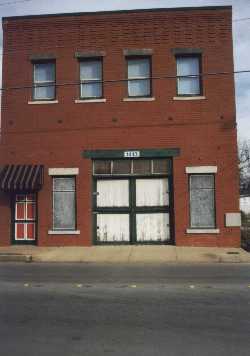
1413 VAUGHN BLVD. c 1913. The Fire Dept. and City
Hall shared the building in 1921. Later it became Fire Station #14 when
Poly was annexed by Ft. Worth. It was Partlow's Bakery in the late 1950's
when I would buy donuts there.
|